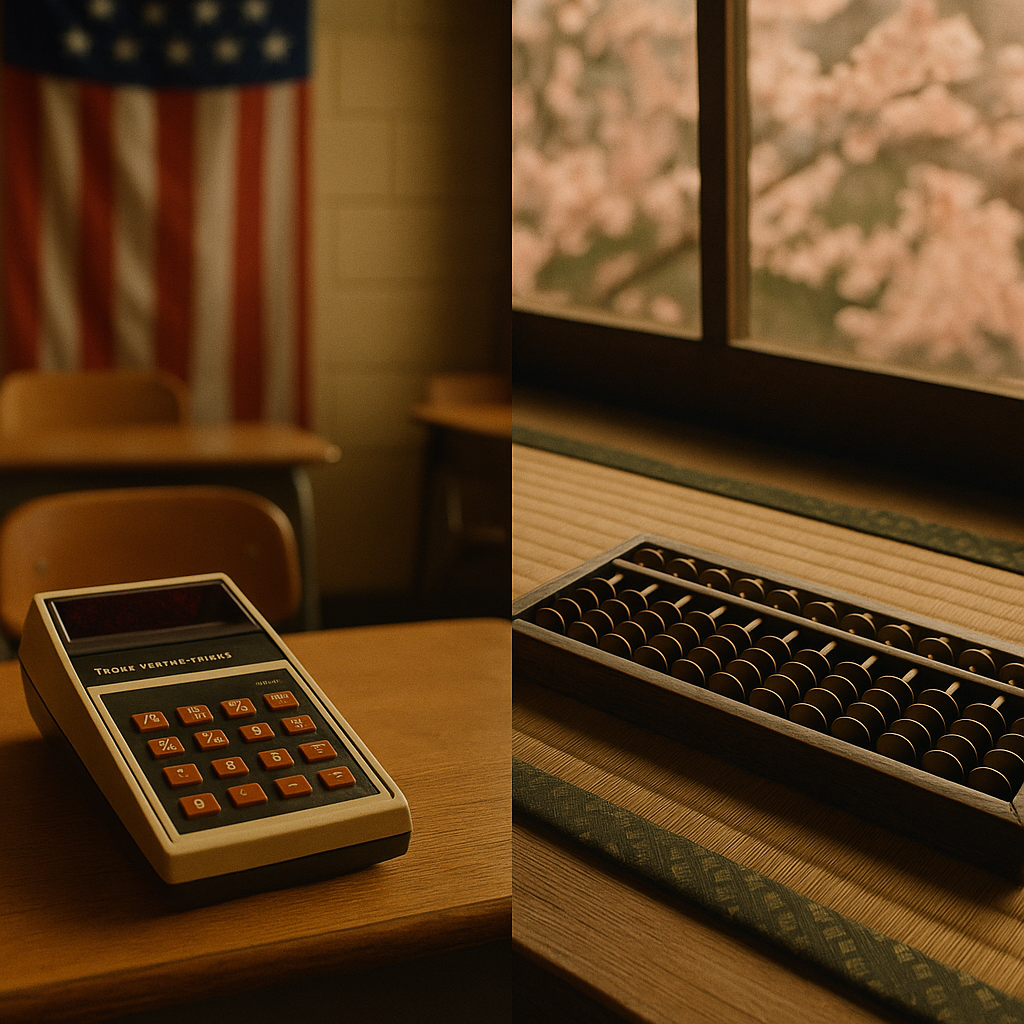
The Calculator Won: Why the Abacus Never Reached American Schools
In Japan, every third-grader learns soroban. In the US, we relegated it to preschool counting toys. Here's what happened—and what we're missing.
Every Japanese third-grader spends part of their school day manipulating beads on a soroban, the Japanese abacus. They learn to add, subtract, multiply, and divide—first with the physical tool, then by visualizing it mentally. By fifth grade, many can perform multi-digit arithmetic faster than most adults can type numbers into a calculator.
In American schools, the abacus sits in preschool classrooms as a counting toy. We teach kindergarteners to slide colorful beads along wires to learn "1, 2, 3, 4, 5," and then we move on. By third grade, the abacus is gone, replaced by pencil-and-paper algorithms and, increasingly, by calculators.
This divergence wasn't inevitable. The abacus had a foothold in 19th-century American classrooms. But by the mid-20th century, a combination of pedagogical shifts, technological change, and cultural assumptions pushed it to the margins. Today, as a handful of programs attempt to reintroduce soroban training to U.S. students, we're left wondering: what might have been different?
A Brief, Unremarkable History: The Abacus in America
The counting frame—a horizontal bead rack similar to the Russian schoty—arrived in American classrooms in the 1820s, imported from Europe by educational reformers inspired by Pestalozzi's hands-on teaching methods. Throughout the 19th century, it was a common sight: teachers used bead frames to help children visualize numbers, understand place value, and learn basic arithmetic.
But it never became more than a beginner's tool. American math education was moving toward abstract written methods—Hindu-Arabic numerals, pencil-and-paper algorithms, memorization of math facts. The abacus served as training wheels for counting and simple addition, but teachers didn't develop sophisticated calculation techniques with it. By the early 20th century, progressive educators still supported manipulatives for young learners, but the abacus was just one tool among many, and not a particularly special one.
When electronic calculators became affordable in the 1970s, the abacus's fate was sealed. Why teach students to manipulate beads when they could press buttons? The calculator was faster, more accurate, and represented modernity. The abacus, by contrast, seemed antiquated—a relic from a pre-computational age.
The result: By the 1980s, the abacus had virtually disappeared from American public school curricula. It survived only in two narrow contexts:
- Early childhood education: As a simple counting manipulative for ages 4-6
- Special education for the blind: The Cranmer abacus remains essential for visually impaired students who can't use pencil and paper
In mainstream elementary education, from first grade onward, the abacus was effectively extinct.
Meanwhile, in Japan: A Different Path
Japan's experience with the soroban followed an entirely different trajectory. Introduced from China in the 15th century, the soroban was refined over centuries into a sophisticated calculation tool. By the late 19th century, Japanese mathematicians had standardized techniques for addition, subtraction, multiplication, division—even square roots.
In 1938, Japan's Education Ministry made a decisive move: they formally included soroban operation techniques in the national elementary arithmetic curriculum. This wasn't a suggestion; it was mandated instruction. Every Japanese child would learn to calculate on the abacus.
Even as Japan modernized rapidly—embracing computers, electronics, and cutting-edge technology—the soroban remained in classrooms. When debates arose in the post-war period about whether it was still relevant in the calculator age, the government doubled down. In 1989, far from phasing out the soroban, the Ministry of Education expanded instruction to include both third and fourth grades.
Why? The reasoning wasn't nostalgia. It was pedagogical:
- Mental calculation skills: Soroban training develops anzan—the ability to visualize an abacus mentally and perform calculations without a physical tool
- Number sense: Constant manipulation of place values builds deep understanding of how numbers work
- Cognitive benefits: Research suggests soroban training enhances working memory, concentration, and numerical processing
- Cultural continuity: Soroban proficiency is a mark of academic discipline and mathematical skill
Today, Japanese elementary students still receive systematic soroban instruction. After-school soroban academies (juku) operate across the country, where children practice for certification exams that millions have taken since 1928. Elite soroban users can add 10-digit numbers in seconds and perform complex mental arithmetic that looks like magic to untrained observers.
The Cost of the Calculator: What We Gave Up
American education made a bet: calculators would render manual calculation obsolete, so we could skip the tedious bead-pushing and focus on higher-order mathematical thinking.
The bet hasn't paid off.
U.S. students consistently struggle with basic arithmetic fluency. National assessments show that many fourth-graders can't reliably add two-digit numbers with regrouping. Mental math is nearly non-existent—ask an adult to compute 47 + 38 without pencil, paper, or phone, and watch them struggle.
This isn't just about speed. Weak number sense undermines everything that comes later. If students don't have an intuitive grasp of how numbers combine, decompose, and relate to each other, they'll struggle with fractions, algebra, and every subsequent mathematical concept.
Calculators haven't freed students to focus on "higher-order thinking." Instead, they've created a generation that can't estimate, can't verify answers for reasonableness, and reaches for a device to compute 15% of $40.
The Japanese approach suggests an alternative. What if calculation fluency isn't a tedious prerequisite to real math, but rather the foundation that makes advanced thinking possible? What if the hours spent manipulating beads—making tangible the abstract relationships between numbers—builds cognitive infrastructure that no calculator can replace?
What Japan Has That We Don't
The difference isn't just about soroban vs. no soroban. It's about fundamentally different assumptions about what elementary math education should accomplish.
Mental Math as a Core Skill
In Japan, mental calculation is an explicit instructional goal. Students are expected to compute multi-digit problems in their heads by visualizing the soroban. This isn't parlor trick memorization—it's systematic training in holding numerical representations in working memory and manipulating them mentally.
American students, by contrast, are rarely taught mental math as a distinct skill. We emphasize written algorithms and, increasingly, calculator use. Mental math is something clever kids figure out on their own, not something we systematically cultivate.
Calculation as Understanding, Not Just Procedure
When Japanese students use the soroban, they're not just executing algorithms—they're physically manipulating place values, seeing how carries propagate, feeling the structure of multidigit operations. The tool makes the abstract concrete.
American algorithms (the "carrying" method for addition, long division, etc.) are taught as procedures to memorize. Many students execute them correctly without understanding why they work. The soroban forces understanding because you can't manipulate it correctly without grasping the underlying place value logic.
Patience for Mastery
The Japanese curriculum assumes that students need years of practice to develop true computational fluency. Soroban training starts in third grade and continues through elementary school. After-school programs extend this to thousands of hours of deliberate practice.
American education is impatient. We introduce concepts quickly, provide limited practice, and move on. "They can use a calculator" becomes the escape hatch when fluency doesn't develop.
The Transformative Potential: What Could Change
Imagine if American elementary schools adopted soroban training comparable to what Japan mandates. What would change?
1. Number Sense as a Foundation
Students who spend hundreds of hours manipulating an abacus develop an intuitive understanding of:
- Place value: Each column represents a power of ten, visibly distinct
- Decomposition: Numbers break apart and recombine fluidly (47 is "4 tens and 7 ones")
- Magnitude: Larger numbers require more columns; the scale is visible
- Operations: Addition is physically "adding beads"; subtraction is "removing beads"
This isn't abstract knowledge you memorize for a test. It's embodied understanding that makes every subsequent mathematical concept more comprehensible.
2. Mental Calculation That Actually Works
The progression from physical soroban to mental visualization (anzan) creates a lasting mental tool. Students learn to:
- Hold visual representations in working memory
- Manipulate those representations systematically
- Compute without external aids at remarkable speed
This isn't about competing with calculators—it's about having a reliable internal verification system. Can the student tell if the calculator's answer makes sense? Can they estimate before computing? With mental math fluency, yes.
3. Cognitive Benefits Beyond Math
Research on abacus-trained students (primarily from Asia) suggests broader cognitive gains:
- Working memory: Holding and manipulating visual-spatial information improves general working memory capacity
- Concentration: Hours of focused bead manipulation builds sustained attention
- Confidence: Mastery of calculation builds mathematical self-efficacy
One neuroscience review found that abacus-based mental calculation training enhances mathematics ability, working memory, and numerical processing, with measurable changes in brain regions linked to memory and reasoning.
4. Equity and Accessibility
The soroban is fundamentally democratic:
- Low cost: A durable wooden abacus costs $10-20 and lasts decades
- No prerequisites: Any child can start with basic counting
- Immediate feedback: You can see if your answer is right by reading the beads
- Scalable: One teacher can guide 30 students practicing individually
Compare this to educational software (requires devices, internet, maintenance) or intensive tutoring (expensive, doesn't scale). The soroban is cheap, robust, and proven.
The Reality Check: Where's the "Revival"?
The research document provided claims a "revival" of abacus education in U.S. schools. Let's be honest about what that means.
The truth: There is no meaningful revival in American public schools.
Yes, there are efforts:
- DRANREF Foundation's Abacus Project ran pilot programs in D.C., reporting that 89% of students improved math fluency over 12 weeks
- Private programs like UCMAS, ALOHA, and others operate after-school centers in major cities
- Some elementary schools offer abacus as an optional after-school club
But scale matters. Since 2015, the DRANREF Foundation has reached about 2,000 students and 170 teachers—across the entire United States. For context, there are roughly 35 million elementary school students in the U.S.
The "revival" consists of:
- A handful of pilot programs in individual schools
- Private enrichment centers serving families who can afford them (typically $100-200/month)
- Scattered after-school clubs with limited capacity
This is not a revival. This is boutique experimentation.
No state has adopted soroban training in their standards. No major school district has made it part of the core curriculum. Teacher preparation programs don't train educators in soroban instruction. The federal government hasn't funded large-scale research or implementation.
The abacus remains, as it has been for 50 years, marginal in American education.
Why the Revival Isn't Happening (And Won't Soon)
Several structural barriers prevent widespread adoption:
1. Curricular Inertia
American math standards (Common Core, state frameworks) don't mention the abacus beyond kindergarten manipulatives. Changing standards is a slow, politically fraught process. Without standards support, textbook publishers won't create soroban materials, and schools won't adopt them.
2. Teacher Training
No U.S. teacher preparation program trains elementary educators in soroban instruction. Even if a school wanted to adopt it, where would they find qualified teachers? You can't mandate something the workforce isn't prepared to teach.
3. The Calculator Culture
American culture deeply believes that manual calculation is obsolete. "Why waste time on that when they have calculators?" is the dominant view. Convincing educators, administrators, parents, and policymakers that calculation fluency matters requires shifting a decades-old consensus.
4. No Compelling Crisis
Until student math performance becomes a genuine crisis that demands novel solutions, inertia will win. The current approach is "good enough"—we can point to some students who succeed, blame failures on external factors, and continue business as usual.
5. Equity Optics
Ironically, the abacus can be dismissed as culturally foreign ("That's an Asian thing") or antiquated ("We're not going back to the 1800s"). Any proposal to adopt techniques from other countries faces suspicion and resistance.
What It Would Actually Take
If the U.S. wanted to seriously integrate soroban training into elementary math education, here's what would be required:
Phase 1: Research and Pilot Programs (5 years)
- Randomized controlled trials comparing soroban-trained students to matched controls on standardized math assessments
- Longitudinal studies tracking cognitive development and long-term outcomes
- Implementation research documenting teacher training requirements, student engagement, and cost-effectiveness
- Curriculum development aligning soroban instruction with Common Core and state standards
Estimated cost: $50-100 million for rigorous research across multiple sites
Phase 2: Teacher Preparation (10 years)
- Pre-service training: Integrate soroban instruction into elementary education programs at universities
- In-service professional development: Train current teachers through workshops, coaching, and certification programs
- Master teacher networks: Create cohorts of soroban specialists who can mentor peers
Estimated cost: $500 million - $1 billion for national-scale training infrastructure
Phase 3: Curriculum Integration (10 years)
- Standards revision: Update state math standards to explicitly include soroban/mental math outcomes
- Materials development: Create textbooks, digital tools, and assessment instruments
- Implementation support: Provide ongoing coaching and resources to schools
Estimated cost: Billions of dollars (standards change is politically expensive; materials development is ongoing)
Total Timeline: 20-25 years from serious commitment to widespread practice
This is not happening. There is no political will, no funding, and no constituency demanding it.
So What Can We Do?
If a national transformation isn't coming, individual educators and parents still have options.
For Teachers
- Experiment in your classroom: Use soroban as a manipulative for place value and mental math, even if it's not in your curriculum
- Start an after-school club: Offer abacus as enrichment for interested students
- Share results: Document student progress and share with colleagues to build interest
For Parents
- Enroll in private programs: UCMAS, ALOHA, and similar centers exist in many cities
- Learn together at home: Purchase a soroban ($10-20) and use online tutorials (YouTube has many excellent series)
- Advocate for school adoption: Ask your school's math department to consider pilot programs
For Education Leaders
- Fund pilot studies: Small-scale experiments in a few schools can generate local evidence
- Partner with researchers: University education departments may be interested in studying implementation
- Connect with existing programs: The DRANREF Foundation and other nonprofits offer training and materials
For All of Us: Use Tools Like This One
The website you're on right now—Abaci.one—exists because mainstream education isn't meeting this need. We're building open-source tools to make soroban training accessible:
- Interactive tutorials for learning to read and manipulate the soroban
- Practice games that build mental calculation fluency
- Printable flashcards for deliberate practice
- Research-based pedagogy grounded in learning science
You don't need to wait for your school district. You don't need to pay $200/month for classes. You can start today, for free, right here.
The Bigger Picture: What the Abacus Represents
This isn't really about beads and wires. The abacus is a proxy for a deeper question: What do we believe about how children learn mathematics?
The American approach assumes:
- Abstract symbolic manipulation is sufficient
- Calculators make manual calculation obsolete
- Speed matters more than understanding
- Innovation means new technology, not old tools refined
The Japanese approach (and that of many Asian countries) assumes:
- Embodied, physical practice builds durable understanding
- Mental calculation develops cognitive skills beyond computation
- Mastery requires thousands of hours of deliberate practice
- Old tools, deeply understood, can be more powerful than new ones superficially adopted
We chose calculators. They chose soroban. The results speak for themselves.
International assessments consistently show Japanese students outperforming American peers in mathematical problem-solving, number sense, and computational fluency. This isn't solely because of the soroban—Japan invests heavily in math education overall—but it's a piece of the puzzle we've ignored.
A Modest Proposal
We're not going to transform American math education overnight. But we could start with something achievable:
Make mental math a valued, explicitly taught skill in elementary school.
It doesn't have to be soroban (though that would be great). It could be:
- Vedic mathematics (Indian mental math techniques)
- Number talks (structured classroom discussions about mental strategies)
- Estimation routines (daily practice with reasonable approximation)
- Rekenrek (the Dutch arithmetic rack, already used in some U.S. classrooms)
The specific tool matters less than the commitment: We teach students to compute mentally, systematically, with sufficient practice to develop real fluency.
If we made this commitment, the soroban would be an obvious candidate for inclusion. It's proven, it's cheap, it's scalable, and it works. But even if we never adopt it, we could learn from the principle it represents: computational fluency isn't the enemy of conceptual understanding. It's the foundation.
Try It Yourself
Don't take my word for it. Spend 20 minutes learning to add two-digit numbers on a soroban. You'll experience:
- How visible place value becomes when each column is physically distinct
- How regrouping (carrying) makes tangible sense when you physically move beads
- How mental visualization naturally develops from physical practice
- Why students trained this way develop both speed and understanding
We've built an interactive tutorial right here at abaci.one/tutorial. It's free, it's self-paced, and it will convince you—more than any essay could—that there's something powerful here we've been missing.
The Uncomfortable Truth
The abacus never reached American schools because we decided it wasn't worth the effort.
We had it. We used it. And we consciously chose to set it aside when calculators appeared. That choice made sense in the moment—why cling to old tools when new ones are available?
But Japan made a different choice. They kept the soroban, integrated it into their curriculum, and systematically developed their students' mental calculation abilities to levels we can barely imagine.
Fifty years later, the results are in. They were right. We were wrong.
The question now is whether we have the humility to admit it, and the will to do something about it.
Probably not. American education is extremely resistant to learning from other countries, especially when it means acknowledging that older methods might be superior to our "modern" approaches.
But maybe, at the margins, some teachers will try. Some parents will enroll their kids. Some students will discover that moving beads on wires unlocks mathematical understanding in a way abstract algorithms never did.
And maybe, in 20 years, we'll have enough of these stories that someone will finally ask: Why isn't everyone doing this?
That would be a real revival.
Further Reading
- Historical context: Pat Ballew's blog on the abacus in American education documents its early use and decline
- Japanese system: The League of Japan Abacus Associations provides history and current practices
- Cognitive research: Wang et al. (2020), "Abacus Training Enhances Neural Correlates of Phonological Processing," Frontiers in Neuroscience
- Pilot programs: The Abacus Project by DRANREF Foundation
This post reflects our conviction at Abaci.one that accessible, evidence-based tools can democratize mathematical fluency. The soroban won't solve every problem in math education, but it's a proven approach we've foolishly ignored. We're building digital tools to make it accessible to everyone—because no student should be denied effective instruction just because their school made the wrong choice 50 years ago.